
A plenum test measures the air leakage rate through the fabric of a raised-access floor void used for underfloor air distribution. In practice, data centres, trading floors, and technology-intensive offices with underfloor air supply systems typically need plenum testing. This confirms the void meets the specified airtightness performance.
What is Plenum Testing?
Raised-access floor plenums used as supply air distribution voids in commercial buildings must meet a defined air leakage rate to deliver efficient, evenly distributed airflow – set by CIBSE guidance and individual project commissioning specifications. Excessive leakage causes supply air to bypass the occupied zone, reducing ventilation effectiveness and increasing fan energy, with remediation becoming costly once floor tiles are fully installed. Build Energy carries out plenum air leakage testing using calibrated fan pressurisation equipment for commercial fit-outs, new builds, and refurbishment projects across the UK.
Plenum testing demonstrates the air tightness of the space below Raised Access Floors. Achieving air tightness in plenums is critical in achieving efficient air handling within buildings, and a rigorous test regime must meet design specifications.
What is a plenum?
A plenum is a void that is typically created beneath a Raised Access Floor in a place of work or education. Compared to using ductwork, plenums are a more efficient way of distributing fresh heated or conditioned air throughout large areas.
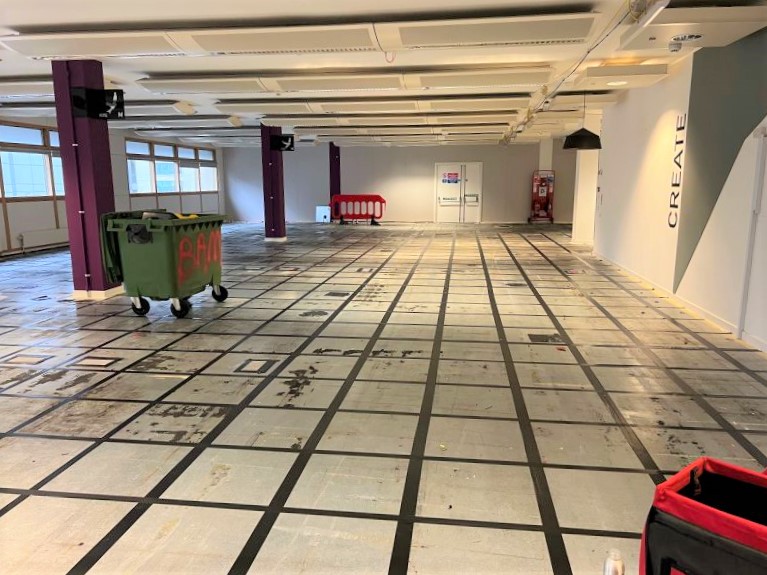
In recent times, indoor air quality is becoming increasingly important, and this is one of the strategies being employed. For this system to be efficient, there needs to be some degree of air tightness so that air is distributed in the way the plenum was designed.
Air Tightness Specifications
Many plenums are designed to use the specifications set out in the BSRIA guide, where the plenum must perform below 0.7 l/s/m² at 50 Pa.
This is often very hard to achieve due to the amount of cable and service penetrations. To achieve this, it is important to plan how to carry out all works around the plenum to not affect the integrity. If the test does fail, then a very conscientious approach must be taken to complete remedial sealing across the entire perimeter, which is often costly and time-consuming.
| Guidance / Standard | Maximum Air Leakage | Test Pressure | Notes |
|---|---|---|---|
| BSRIA Guide BG 7 | ≤0.7 l/s/m² at 50 Pa | 50 Pa | Standard commercial target – most widely specified |
| Project specification | Per design brief | 50 Pa | Client or M&E engineer may set tighter limits |
| BREEAM assessment | Per credit criteria | 50 Pa | May require pre- and post-completion tests |
Plenum Testing – How It Works
The test has the same principle as a building air tightness test, with a few exceptions.
For a Raised Access Floor, two tests are often required. One with the floor tiles taped, and one without tape. This will allow us to work out the leakage of the plenum and the floor tiles separately.
Many buildings will also require testing to achieve a leakage rate at a different pressure, such as 25 Pa.
With a building air tightness test, it is easier to see where air is escaping by using smoke when inside the building. As it is hard to safely be inside a sealed plenum during a test, engineers use different techniques, mainly experience and large smoke machines.
Tips and preparation
Before the taping takes place, we recommend sealing all the ductwork openings or the air handling units. To avoid any being missed, consult the drawings to identify where these are in the plenum.
During the installation of ductwork, it is common to miss out the sealing beneath the duct where it penetrates the wall, and this is then very difficult to seal at a later stage due to often being flush with the floor slab. When planning the work with the contractors, we’d recommend highlighting this area and installing an airtight seal beneath the duct.
Cabling considerations
Cable penetrations are often hard to effectively seal when bunched up in large trunks, or on cable trays. Again, seal beneath the cable tray before adding any cables.
When fitting the cables, especially when they are large in number, the best practice would be to lay a bead of mastic/sealant, then sit some of the cables into this so that they are not touching at the perimeter of the plenum. Once this has dried, apply another bead of mastic/sealant on top of these cables and repeat with another group of cables. This is going to be especially important in smaller plenums where there is less allowable leakage area available.
For conduits, as well as sealing around where they penetrate the wall, it is best practice to seal them inside too. Open the conduit where it penetrates the wall for the best effect.
Plasterboard on internal and external walls may not be effectively sealed at the base, meaning air can escape from the plenum and up into the rest of the building. A continuous and thorough mastic seal across the base of the plasterboard before the Raised Access Floor goes in. Work quickly and effectively across the entire perimeter.
Related Services
For building fabric airtightness testing, see Air Tightness Testing. If you need pressurisation testing in smoke control shafts, see Smoke Shaft Testing. For design-stage guidance, see Air Tightness Consultancy. Return to the Air Tightness services hub.
Frequently Asked Questions
What is a raised-access floor plenum?
A raised-access floor plenum is the void beneath a raised floor system used as a supply air distribution path in commercial HVAC. Air enters the void at low pressure and flows into the occupied space via floor grilles. The plenum must be sufficiently airtight to deliver the designed airflow efficiently.
Why does a floor plenum need an air leakage test?
Excessive plenum leakage causes supply air to bypass the occupied zone, creating hot or cold spots, reducing ventilation effectiveness and increasing fan energy. Plenum testing quantifies the leakage rate so the HVAC commissioning team can assess whether it meets the design specification.
How is plenum testing carried out?
Build Energy pressurises the floor void using a calibrated fan connected through a temporary seal over a floor grille. Engineers measure the fan flow rate at a standard test pressure and normalise it against the plenum area or volume to give a leakage coefficient, compared against the design specification or CIBSE guidance.
What causes excessive plenum leakage?
Common sources include gaps around floor tiles, unsealed cable entry points, poorly fitting perimeter trim, gaps around columns and partitions, and leakage through the structural slab. Build Energy identifies dominant leak sites during the test and advises on remediation.
When should you carry out plenum testing?
Carry out the test after fitting all raised floor tiles and sealing the perimeter, before the HVAC system is fully commissioned. Early testing helps resolve leakage issues before the fit-out is complete.
What specification does a plenum air leakage test need to meet?
In practice, most commercial projects use the BSRIA Guide BG 7 target of 0.7 l/s/m² at 50 Pa as the benchmark. However, this figure is not mandatory – the required specification depends on the project contract, the M&E engineer’s design intent, or any BREEAM credit being targeted. In particular, tighter limits may be specified for data centres or critical environments where controlled airflow is essential. Build Energy can test against any stated specification and provide a pass/fail result with a detailed on-site report.
How should I prepare a raised-access floor plenum for testing?
Preparation is the most important factor in achieving a plenum pass. Generally, all cable and pipe penetrations through the plenum perimeter should be sealed before the test date, using appropriate fire-rated or air-stopping mastic. Additionally, all floor tiles must be in place and perimeter strips fitted. In contrast to building-envelope air tightness tests, internal plenum tests do not require the building to be unoccupied – however, mechanical ventilation serving the plenum should be isolated during the test to prevent interference with the fan readings.
Call 0330 055 34 05 · email be@buildenergy.co.uk · or tell us about your project →