
Air tightness testing measures the rate at which air leaks through a building’s fabric, expressed as air permeability in m³/hr/m². Under Part L of the Building Regulations, new dwellings and many commercial buildings must meet a target air permeability. In addition, a proportion must complete a formal pressurisation test and submit results to Building Control.
What is Air Tightness Testing?
Air permeability testing – also known as an airtightness test or blower door test – measures uncontrolled air leakage through the building fabric. Results are expressed in cubic metres per hour per square metre of envelope area at 50 Pascals. The test is required under Part L of the Building Regulations for all new dwellings and non-domestic buildings in England and Wales. It must be carried out by a certified tester and submitted as part of the as-built SAP or SBEM compliance report before a completion certificate can be issued.
Build Energy’s certified testers carry out air permeability tests on residential and commercial buildings across the UK.
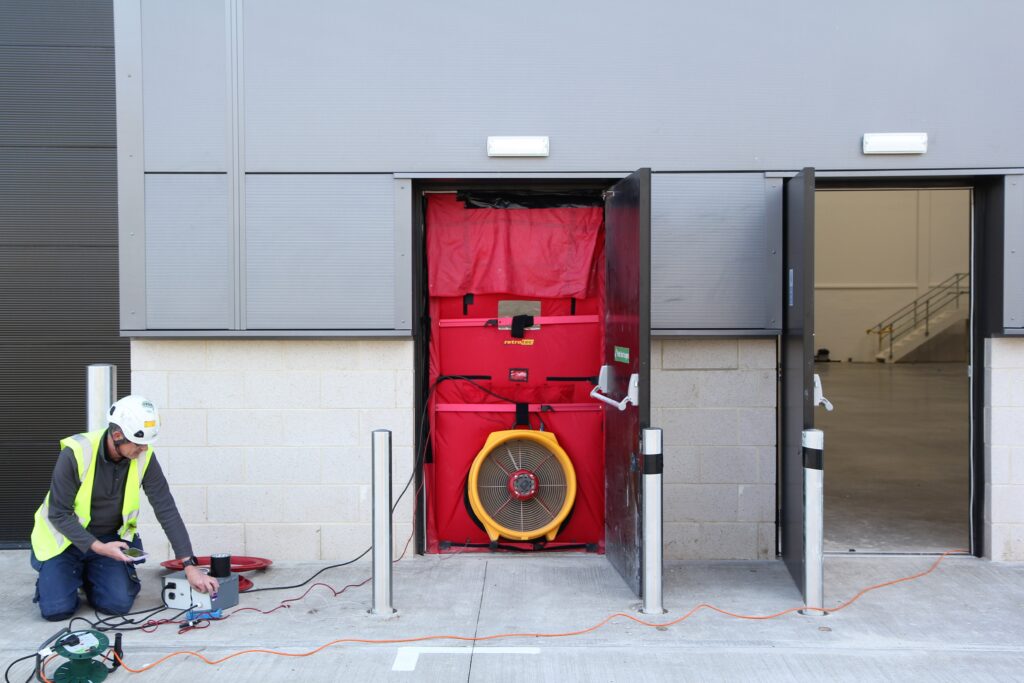
Uncontrolled air leakage through the fabric of a building creates heat loss. It also significantly affects the energy performance rating in standard assessment tools like SAP and SBEM. Air testing is a requirement for new buildings under Part L of the Building Regulations. Our technicians deliver testing across the UK for all types of domestic and non-domestic buildings. This forms a key part of our end-to-end set of compliance services.
Why Choose Build Energy?
- We can assist with early stage consultancy and design advice
- We provide a seamless service to manage your building regulations compliance when combined with SAP Calculations and SBEM Calculations
- Full UK coverage – no mileage charges
- Local, accredited engineers covering Dorset, Hampshire and Wiltshire from our Christchurch office, with same-day certification for nearby sites
- Vastly experienced team of EAS Accredited engineers
- Advice and consultancy available throughout the design and construction process
- Practical guidance and advice prior to testing
- Smoke investigation to diagnose issues
- Same day certificates when you need them fast
When Is Air Tightness Testing Required?
Part L of the Building Regulations determines whether air tightness testing is mandatory. In general, new dwellings and new non-domestic buildings must test; refurbishments and extensions are generally exempt unless required by planning conditions, BREEAM, or an enhanced energy strategy.
| Building Type | Regulation | Testing Required? | Max Permeability |
|---|---|---|---|
| New dwellings | Part L1A | Yes – sample protocol available | 5 m³/(h·m²) at 50 Pa |
| New non-domestic buildings | Part L2A | Yes – all buildings | 10 m³/(h·m²) at 50 Pa |
| Refurbishments | Part L1B / L2B | Not mandatory; may apply via BREEAM or planning | Project-specific |
| Extensions | Part L1B | Not required for the extension alone | N/A |
Air Tightness Testing for Dwellings
Airtightness testing is a mandatory requirement for newly built dwellings under Part L of the Building Regulations – and a pre-requisite for producing final SAP Calculations. Some caveats apply for sample testing. However, most clients now choose to have every individual dwelling tested to meet increasingly demanding energy efficiency targets. An absolute maximum leakage rate of 5 ³/(h·m²) applies to new homes.
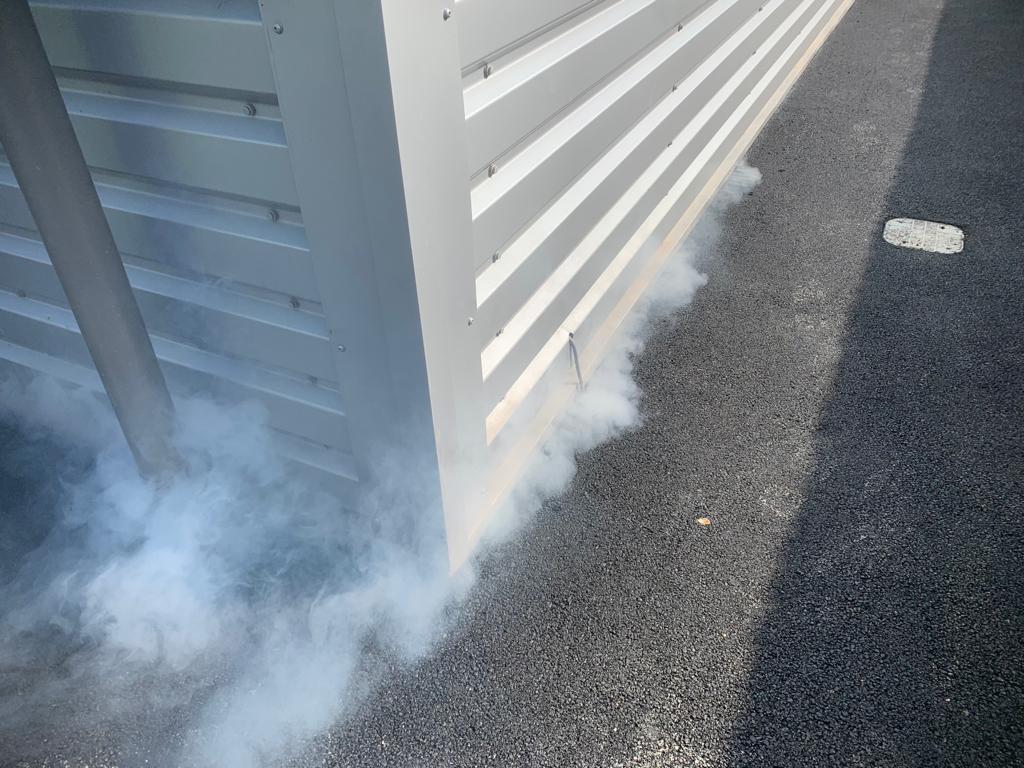
Smoke Diagnostic Testing
Air Tightness Testing for Non-Dwellings
Airtightness Testing is a mandatory requirement for newly built non-dwellings. Part L2A of the Building Regulations requires testing – and is a pre-requisite for producing final SBEM Calculations and BRUKL Reporting. At Build Energy, we provide not only testing but early stage consultancy for any type of building. This includes offices, retail units, schools, and libraries, as well as publicbuildings and warehouses, regardless of size or location.
An absolute maximum leakage rate of 10 ³/(h·m²) applies to non-dwellings, although most schemes will be designed to meet an ‘8’ (more airtight). For more guidance on air permeability targets and what results mean, see our blog post: Air Permeability Testing – Get Your Building Airtight.
Related Services
Air tightness results feed directly into SAP calculations for dwellings. For design-stage support, see Air Tightness Consultancy. Other air leakage services include Smoke Shaft Testing and Plenum Testing. For UK-wide Building Regulations coverage, see the Air Tightness hub. If you’re based in Dorset, Hampshire or Wiltshire, our local air tightness testing page has area-specific coverage and pricing.
Frequently Asked Questions
How does airtightness testing work?
Specifically, air tightness testing uses a calibrated fan (blower door) temporarily fitted into a doorway. The fan depressurises the building to 50 Pascals below ambient pressure. Engineers measure the flow rate needed to maintain that pressure difference. They then divide it by the building envelope area to give the air permeability result in m³/h.m² at 50 Pa.
How long does an air tightness test take?
Typically, tests take between two and four hours on site, depending on the size of the building and any remediation works needed. A basic test on a single dwelling typically takes around one hour. Build Energy can often attend the same day or within 24 hours for urgent completions.
How many air tightness tests does a project need?
Not every dwelling needs an individual test. Part L1A allows a sampling protocol for large residential developments. Developers must test three dwellings of each type or 50% of dwellings, whichever is the lesser. Any that fail must be remediated and retested. Untested dwellings then use the average result for their type, plus a +2 m³/(h·m²) penalty margin. As a result, the design air permeability (DAP) should be set no greater than 3 m³/(h·m²). This reliably meets the 5 m³/(h·m²) target. Non-domestic buildings have no sampling option – Part L2A requires every new commercial or public building to test, as part of the SBEM compliance process. Build Energy advises on the most cost-effective testing strategy for each scheme.
What is a good air tightness test result?
Part L1A sets a maximum air permeability of 5 m³/(h·m²) for new dwellings and 10 m³/(h·m²) for non-domestic buildings. Both figures are measured at 50 Pa. A good result sits comfortably below these limits. Most consultants design non-domestic buildings to a target of 8 m³/(h·m²) or better, while high-performance homes typically target 3 m³/(h·m²) or better. Passivhaus certification requires 0.6 air changes per hour at 50 Pa. The lower the result, the less heat is lost through uncontrolled air leakage. It also means a better SAP or SBEM energy performance rating for the building.
Who provides air tightness testing in the UK?
Air tightness testing must be carried out by a certified tester. The result is then submitted as part of the as-built SAP or SBEM assessment. Build Energy’s accredited testers carry out air permeability tests on new dwellings under Part L1A and non-domestic buildings under Part L2A. This covers England and Wales, and we provide the compliance report required before a completion certificate can be issued. For specialist enclosures we also provide Smoke Shaft Testing and Plenum Testing, and for practical guidance on preparing your site before test day, see what you can seal for an air tightness test.
Does air tightness testing apply to refurbishments?
Air tightness testing is not mandatory for refurbishments under Part L1B or L2B. However, a refurbishment project may still require a test. This applies if it is subject to a BREEAM assessment, if planning conditions require enhanced energy performance, or if the project team has adopted a Passivhaus or net-zero carbon strategy. Where testing is voluntary, it remains the most reliable way to identify infiltration paths before they are sealed behind new finishes. As a result, early-stage testing is particularly valuable on deep retrofit projects.
How much does an air tightness test cost?
Overall, air tightness test costs vary depending on building type, size, and the number of units being tested. A single new dwelling typically costs between £300 and £600. A non-domestic building with multiple test points, however, will be priced individually based on floor area and access requirements. Build Energy provides fixed-price quotations for all projects. Contact us with your drawings or planning approval, and we will confirm pricing within one working day.
Is a BREEAM air tightness test different from a standard Part L test?
The physical test procedure is identical. Both use a calibrated fan pressurisation unit and measure air leakage at 50 Pa in accordance with ATTMA TSL1 or TSL2. The difference lies in the target. Part L requires a maximum of 10 m³/(h·m²). BREEAM credits, however, are awarded on a sliding scale, with Excellent requiring 3 m³/(h·m²) or better and Outstanding requiring 1.5 m³/(h·m²). Build Energy can certify results for both Part L compliance and BREEAM submission simultaneously.