
First developed in 1990 by BRE, BREEAM is now specified as a planning condition on commercial developments, schools, hospitals and larger residential schemes. Planning authorities, housing associations and government procurement frameworks routinely require a minimum BREEAM Excellent or Outstanding rating. An accredited BREEAM assessor registers and assesses the project under the relevant BRE scheme standard.
What is BREEAM and How Does Certification Work?
Although it is commonly applied to UK projects, BREEAM is a globally recognised standard and allows the assessment and benchmarking of new and existing property assets across a multitude of building types. BREEAM addresses design, construction and operation phases.

What is a BREEAM Assessment?
BREEAM assessment uses recognised measures of performance to evaluate a buildings specification, design construction and use across:
- Energy and water use
- Internal environment (health & wellbeing)
- Management processes
- Pollution
- Transport
- Materials
- Waste
- Ecology
BREEAM Rating
Credits are awarded in the sections listed above and added together to give a final rating. The table below shows the percentage scores required for each BREEAM rating.
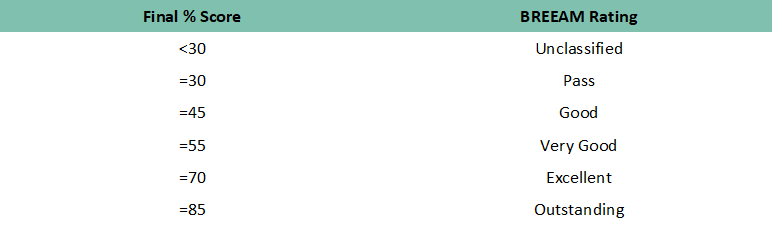
| BREEAM Rating | Score Required | Typical Requirement |
|---|---|---|
| Outstanding | ≥85% | Net zero / exemplar projects |
| Excellent | ≥70% | Government, NHS and many commercial planning conditions |
| Very Good | ≥55% | Common planning minimum for mixed-use and residential |
| Good | ≥45% | Lower-tier commercial and some housing projects |
| Pass | ≥30% | Minimum certification threshold |
| Unclassified | <30% | Not certified |
BREEAM Certification
The BREEAM assessment consists of two stages – Design and Post Construction, with an optional Post Occupancy stage. Your assessor will gather evidence from your team at each stage and compile this into a report to send to BRE, who will provide the final certification.
Need an accredited BREEAM assessor? Find out how Build Energy’s BREEAM assessors can help with your project →
Why use BREEAM?
BREEAM addresses wide ranging environmental and sustainability issues and enables various stakeholders from planners and building owners, to clients and contractors with a means of certifying performance.
Importantly, BREEAM looks beyond operational carbon alone, taking a holistic approach to the lifecycle of a building and its environmental, social and economic sustainability performance.
BREEAM assessments can be applied to:
- New Construction
- Non Domestic Refurbishment and Fit Out
- BREEAM Domestic Refurbishment (formerly assessed under Ecohomes)
Project Types
BREEAM schemes address all major building types and project categories:
- Commercial buildings – Offices, Industrial and Retail
- Public buildings – Courts, Education, Healthcare, Higher Education, Prisons
- Multi-Residential accommodation
- International
- Communities
- Infrastructure
Minimum Standards
Some public schemes are subject to minimum BREEAM standards across the public sector.
Healthcare
A number of government departments and other public bodies either encourage or require the use of BREEAM.
As of 1st July 2008, all health authorities (Department of Health, NHS Wales, Scottish Government Health Directives and the Department of Health, Social Services and Public Safety of Northern Ireland) require that new healthcare buildings seeking Outline of Business Case (OBC) approval commit to achieving an Excellent rating and all refurbishments commit to achieving Very Good.
Education
There is also a BREEAM requirement set for schools depending on whether they are refurbishments or new builds and the value of the build.
For example secondary schools procured through the now defunct Building Schools for the Future capital programme were required to achieve a ‘Very Good’ rating. We expect the latest Priority Schools Programme to require a similar standard.
Build Energy can assist with the tender process for our clients – providing whatever help you need to effectively price and bid for public and commercial projects. Speak to our accredited BREEAM assessors about your project →
Related BREEAM Services
Build Energy offers the full range of BREEAM services: BREEAM Consultancy, BREEAM Accredited Professional (AP), and Building User Guides. Return to the BREEAM hub. Daylight and sunlight assessments support the Health & Wellbeing category under BREEAM Hea 01 – see our Daylighting Calculations service for ADF and VSC assessments to BR 209. For residential energy compliance, see SAP calculations.
Frequently Asked Questions
What does BREEAM stand for?
BREEAM stands for Building Research Establishment Environmental Assessment Method. It was developed by the BRE (Building Research Establishment) in the UK in 1990 and is now the world’s most widely used green building assessment standard, with over 600,000 buildings certified and more than two million registered for assessment globally. It provides a recognised, independently verified measure of a building’s sustainability performance.
What are the BREEAM rating levels?
BREEAM assessments produce a percentage score based on credits earned across multiple environmental categories. This score maps to one of five ratings: Pass (30%+), Good (45%+), Very Good (55%+), Excellent (70%+), and Outstanding (85%+). The vast majority of planning-required BREEAM assessments specify a minimum of Very Good or Excellent. Outstanding is the highest rating and requires exceptional performance across all categories.
Is BREEAM mandatory in the UK?
BREEAM is not a legal requirement in itself, but it is widely required through the planning system. Many local planning authorities specify a minimum BREEAM rating as a condition of planning consent for commercial, public and larger residential schemes. It is also commonly required under public sector procurement rules, housing association and registered social landlord standards, and private developer sustainability policies. In practice, most commercial and public sector new build projects in the UK now seek BREEAM certification.
What is the difference between BREEAM and an EPC?
An Energy Performance Certificate (EPC) measures only a building’s energy efficiency, expressed as a rating from A to G. BREEAM is a much broader assessment covering nine categories: energy, water, materials, waste, transport, land use and ecology, health and wellbeing, pollution, and management. A BREEAM assessment provides a comprehensive picture of a building’s overall environmental and sustainability performance, not just its energy use. BREEAM certification also requires independent third-party verification by BRE.
Call 0330 055 34 05 · email be@buildenergy.co.uk · or tell us about your project →