
Part F ventilation testing takes place once the installer has finished and before building control sign-off. We test simple extract fans (System 1), continuous extract systems (System 3) and MVHR (System 4). As a result, one visit can cover every house type on a mixed scheme.
We can also carry out air permeability testing on the same visit, which saves time and cost.
What is Part F Ventilation Testing?
Part F of the Building Regulations covers ventilation. For every new home, it requires an on-site airflow test of each mechanical ventilation fan. This shows that each fan extracts or supplies enough air.
The tester records the results on a commissioning sheet. You then send these to building control within five days of the final test and give a copy to the homeowner.
Approved Document F, Volume 1: Dwellings sets out the airflow rates and how to test them. The current 2021 edition came into force in June 2022. However, a new edition takes effect in March 2027, as explained below.
The three types of ventilation system
Approved Document F now uses descriptive names rather than numbers. However, drawings and specifications still often say System 1, 3 or 4, so we show both here.
| Common name | What it is | What we test |
|---|---|---|
| System 1 | Extract fans that switch on when needed, with trickle vents for fresh air | Each extract fan and any cooker hood that vents outside |
| System 3 | Continuous extract from the wet rooms, from one central unit (MEV) or individual fans (dMEV) | Every extract point at its normal and boost settings |
| System 4 | Mechanical ventilation with heat recovery (MVHR), central or room-by-room | Every supply and extract point, plus the overall balance |
System 1 only suits homes that are not built very airtight. If an air test shows a home is tighter than designed, it will usually need a continuous system instead. For that reason, it pays to check this early on schemes aiming for a low air permeability.
Extractor Fan Testing (System 1)
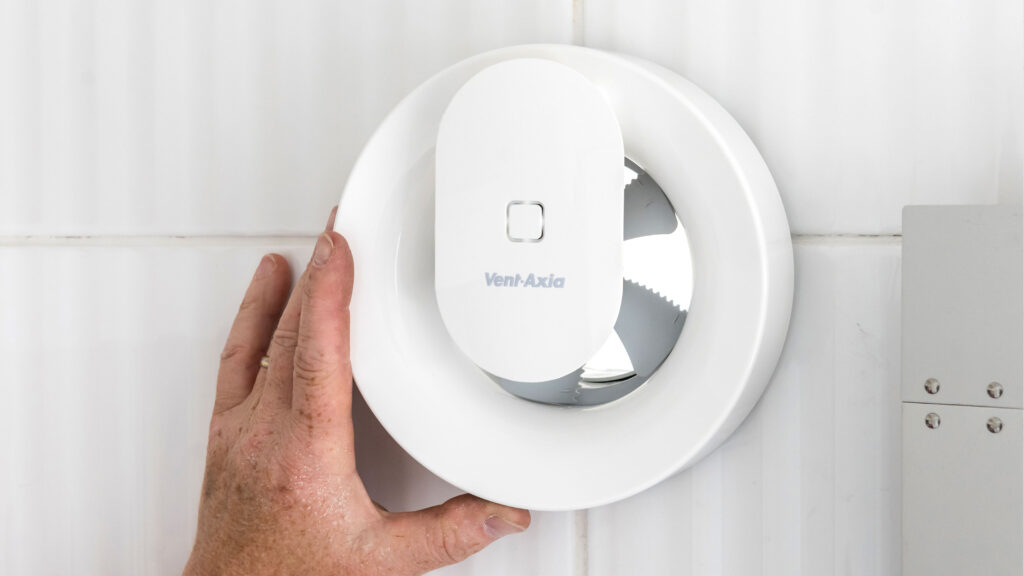
Bathroom extract fan tested at the room grille
Extractor fan testing checks each kitchen, bathroom, utility and WC fan against the minimum rates in the table below. It also covers any cooker hood that vents outside. We measure at the room grille, so the result reflects the whole installation rather than the figure on the box.
When a fan falls short, the cause is usually the installation rather than the fan. The most common culprits are long or kinked duct runs, undersized ducts and underpowered fans.
Our report shows which fans have failed, and our engineers can advise on putting them right before a retest. Our guide to extractor fan ducting covers the usual mistakes and is a useful read before fans go in.
| Room | Minimum extract rate |
|---|---|
| Kitchen with a cooker hood venting outside | 30 l/s |
| Kitchen without one | 60 l/s |
| Utility room | 30 l/s |
| Bathroom | 15 l/s |
| WC | 6 l/s |
Continuous Extract Testing (System 3)
Continuous extract systems run all the time at a low, quiet rate. They then boost when someone uses the kitchen, bathroom or WC.
The system draws stale air out of these rooms. Meanwhile, fresh air comes in through trickle vents in the living rooms and bedrooms. These systems suit any home, including very airtight ones, which is why more and more new housing now uses them.
With a centralised system (MEV), one fan unit in a loft or cupboard connects by ductwork to each wet room. We measure every extract point at normal and boost settings. Then we balance them so each room gets the right amount.
With a decentralised system (dMEV), each wet room has its own fan running continuously. In this case, we set up and test each fan individually.
In both cases we also check that the total running rate is enough for the size of the home.
| Room | Minimum boost rate |
|---|---|
| Kitchen | 13 l/s |
| Utility room | 8 l/s |
| Bathroom | 8 l/s |
| WC | 6 l/s |
We also check the trickle vents during our visit. Missing or undersized vents in living rooms and bedrooms often lead to building control queries.
MVHR Commissioning and Balancing (System 4)
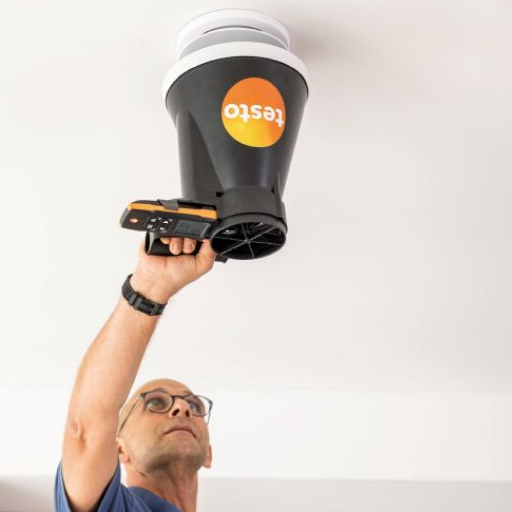
Airflow testing equipment used for Part F ventilation testing
MVHR supplies fresh, filtered air to the living rooms and bedrooms and extracts stale air from the wet rooms. At the same time, it uses the warmth of the outgoing air to heat the incoming air.
Because it both supplies and extracts, the system needs balancing so every room gets the right amount of air. The supply and extract also need to stay in step. Homes with MVHR do not have trickle vents.
Most new homes with MVHR have a central unit ducted to every room. We measure each supply and extract point. Then we adjust the valves and fan speeds until every room reaches its design rate.
We set up and measure room-by-room heat recovery units, which fit through the wall, in the same way.
Balancing a larger MVHR system can take more than one visit, especially if ductwork needs fixing between readings. For this reason, we confirm the likely number of visits when we quote.
How We Carry Out Part F Testing
Before testing, our engineer checks that the trickle vents are open and all doors and windows stay shut. They also check that each fan works correctly from its switch or control. Next, they measure each fan or grille using UKAS-calibrated equipment and a hood that fits over the grille. This means the reading reflects the air actually moving through it.
We record every result on the standard commissioning sheet next to the rate it needs to achieve. That way, you can easily see which fans pass. If anything falls short, it needs adjusting and retesting. We send the completed sheets ready to submit, making the five-day deadline easy to meet.
Changes to Part F Testing from March 2027
A new edition of Approved Document F takes effect on 24 March 2027 for most new homes in England. The required airflow rates stay the same, but testing becomes stricter in a few key ways.
- Testers will need to belong to a scheme that independently checks their competence.
- Testers will need a powered flow hood for continuous systems, and stricter rules will apply to calibrating test equipment.
- MVHR supply and extract will need to balance to within 10% of each other.
- Duct runs will face tighter limits, so it is worth getting the ventilation design checked early.
We are already preparing for these changes. Before March 2027, our engineers will join a competent person scheme and we will use powered flow hoods on continuous systems.
Schemes already underway may be able to continue under the current rules. Therefore, check with your building control body which version applies to your project.
Why Choose Build Energy for Part F Testing?
- All system types tested: extract fans, MEV, dMEV and MVHR
- Reduced rates when combined with air permeability testing on the same visit
- Volume rates for multi-plot schemes
- Coverage across England and Wales
- Experienced, qualified engineers using UKAS-calibrated equipment
- Practical advice before testing to help avoid fails and retests
Related Services
The type of ventilation and its fan and heat recovery performance all feed into the SAP calculation. As a result, the installed system needs to match the one modelled.
For building fabric airtightness, see Air Tightness Testing and Air Tightness Consultancy. For indoor air quality, see our Indoor Air Quality Plan and Indoor Air Quality Testing services, or return to the Air Quality hub.
Frequently Asked Questions
What is Part F ventilation testing?
Part F ventilation testing measures how much air each ventilation fan in a new home moves. It then compares this with the minimum rates in Approved Document F. It covers extract fans, cooker hoods that vent outside, continuous extract systems and MVHR. The tester records the results on a commissioning sheet and sends them to building control.
Which ventilation systems need testing under Part F?
In a new home, every mechanical ventilation fan needs an airflow test. This includes extract fans and cooker hoods (System 1), continuous extract fans (System 3) and MVHR (System 4). Trickle vents do not need an airflow test, but we still check them during the visit.
What is the difference between System 3 and System 4 ventilation?
System 3 only extracts air from the wet rooms, with fresh air coming in through trickle vents. System 4, MVHR, both supplies and extracts air and recovers heat from the outgoing air. As a result, it does not need trickle vents. Both can be a central unit or individual room units.
What happens if ventilation rates are below specification?
Any fan that falls short needs adjusting or fixing and then retesting. Low readings usually come from long or crushed ductwork, undersized ducts, incorrect fan settings or a poorly balanced system. Our report shows which fans have failed, and our engineers can advise on the likely cause before a retest.
Does ventilation testing need to be submitted to building control?
Yes. For a new home, you must send the test results to building control within five days of the final test. You also need to confirm commissioning is complete and give the homeowner a copy of the commissioning sheet.
Do extractor fans need to be tested under Part F?
Yes. In a new home, every extract fan and every cooker hood that vents outside needs testing on completion. Building control then needs the results. We test each fan at the room grille. That way, the result reflects the whole installation, not the fan’s rated performance.
Can Build Energy test ventilation on large residential developments?
Yes. We test extract fans and continuous extract systems and balance MVHR on all kinds of schemes. These range from single plots to apartment blocks and mixed-use schemes across England and Wales. We provide the commissioning sheets building control needs for each home, and volume rates are available for multi-plot schemes.
Will building control always ask for Part F ventilation testing?
Ventilation testing in new homes is a Building Regulations requirement. However, building control bodies still vary in how closely they check it. It is safest to plan testing in from the start. Otherwise, a separate visit late in the build usually costs more and can hold up sign-off.
Can ventilation testing be done on the same visit as air tightness testing?
Yes. The two tests measure different things. Air tightness testing checks the building for leaks, while ventilation testing measures the airflow of each fan. Our engineers can usually carry out both on the same visit. This saves the time and cost of a second trip to site.
What is changing in Part F ventilation testing in 2027?
A new edition of Approved Document F takes effect on 24 March 2027 for most new homes in England. Testers will need to belong to a competence scheme and use a powered flow hood on continuous systems. In addition, MVHR will need to balance within 10%. The required airflow rates are unchanged.
Call 0330 055 34 05 · email be@buildenergy.co.uk · or tell us about your project →