
Part E of the Building Regulations requires pre-completion sound insulation testing on separating walls and floors in new residential developments and conversions. Developers must pass both airborne and impact sound tests and submit results to building control before they can receive a completion certificate. In addition, Build Energy carries out Part E testing across England and Wales, advising on likely failure points before testing begins to maximise first-time pass rates.
When Is Part E Sound Insulation Testing Required?
In order to comply with Part E of the Building Regulations, developments will require the testing of separating walls and floors. The only exception applies where developers have used pre-tested and certified Robust Details.
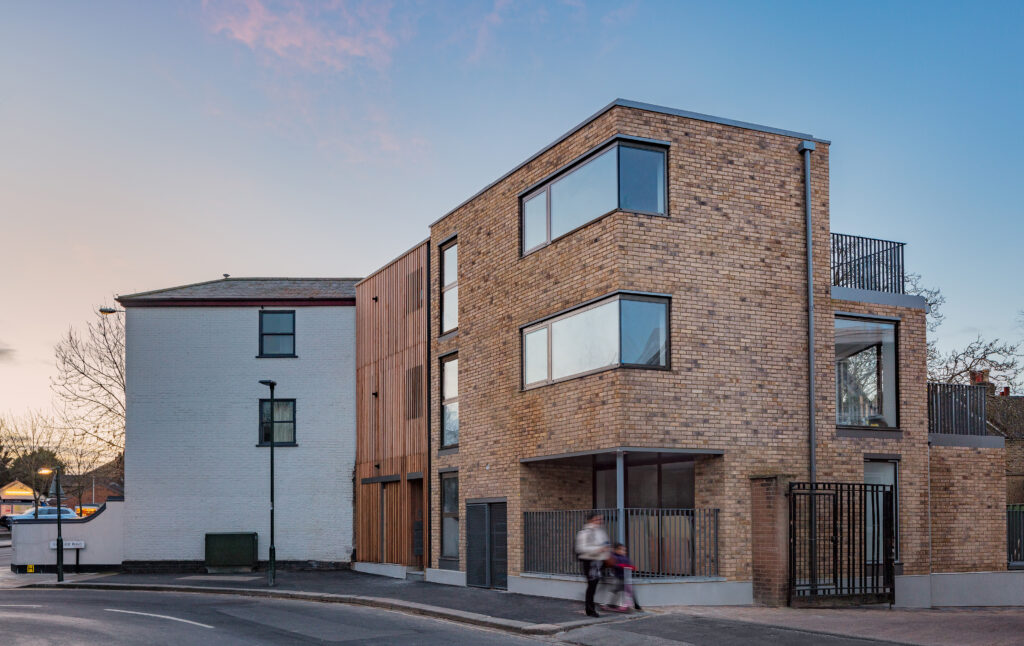
In practice, sound insulation testing checks for both airborne and impact travel through new or existing buildings. This may affect party walls and floors between new and existing buildings, or between spaces within a new development entirely.
Part E of the Building Regulations requires sound insulation testing in the following circumstances:
- Construction of a new development of 2 or more attached dwellings / flats
- Conversion of a former single dwelling into flats
- Construction of a nursing home or rooms for residential use, i.e hotel or hostel
- Designs which do not adhere to Robust Construction Details
Part E Performance Standards
Separating elements must achieve the following minimum values to pass pre-completion testing under Approved Document E:
| Element | Measurement | Minimum Standard |
|---|---|---|
| Separating walls (airborne) | DnT,w+Ctr | ≥ 45 dB |
| Separating floors (airborne) | DnT,w+Ctr | ≥ 45 dB |
| Separating floors (impact) | L’nT,w | ≤ 62 dB |
Complete Acoustic Services
Build Energy partners with UKAS and ANC accredited engineers and consultants to deliver acoustic services across England and Wales. Our team covers sound insulation testing, environmental noise consultancy, acoustic design, and planning noise surveys.
We can help with:
- Sound Insulation Testing
- Environmental Noise Consultancy
- BB93 Acoustic Design in Schools
- Planning Policy Guidance
- Acoustic Design
- Acoustic Enclosure Design and Build
- Noise Mapping & Prediction
- Noise at Work
How Many Tests Do I Need?
The number of tests depends on development size, type, and whether Robust Details have been used. Under the standard regime, a minimum of one set of tests is required for every ten dwellings of each type. Each full set consists of two floor tests (airborne and impact) and two wall tests (airborne). Agree the test programme with building control before work starts – they have discretion to require additional tests.
Where Robust Standard Details (RSDs) are used for all separating elements, reduced sampling is permitted. RSDs cover a range of masonry, timber frame and steel frame construction types. If any non-RSD element is present, full testing applies to those elements.
Common Causes of Test Failure
The most frequent cause of failure is flanking transmission – sound travelling via indirect paths through connected structural elements rather than through the separating element itself. Common failure points include concrete floor slabs running continuously through separating walls, poorly fitted resilient layers, gaps at separating wall junctions, and inadequate acoustic floor screeds.
Build Energy carries out pre-completion acoustic surveys to identify likely failure points before the formal Part E test. Remediating problems before testing is substantially cheaper than failing, remedying, and re-testing – and avoids delays to building control sign-off.
What Happens if a Test Fails?
A failed element must be remediated and re-tested before building control can issue a completion certificate. Common remediation routes include additional acoustic floor screed, sealing gaps at separating wall junctions, or additional resilient layers. Build Energy advises on remediation strategies and carries out re-tests across England and Wales.
Related Services
Sound insulation testing results feed directly into the building control completion process. For acoustic specification, see Acoustic Consultancy. For planning-stage noise surveys, see Noise Impact Surveys. Return to the Acoustics hub.
Frequently Asked Questions
When is sound insulation testing required?
Approved Document E requires sound insulation testing for new dwellings and residential conversions to demonstrate compliance with Part E of the Building Regulations. A suitably qualified acoustic tester must carry out the testing on completion. Developers must submit results to building control before they can receive a completion certificate.
What does sound insulation testing measure?
Part E testing measures airborne sound insulation between rooms (walls and floors between dwellings) and impact sound insulation (floors between dwellings). Results are expressed as DnT,w+Ctr (airborne) and L’nT,w (impact). The minimum values required under Part E are DnT,w+Ctr ≥ 45 dB for walls and floors and L’nT,w ≤ 62 dB for floors.
How many tests are needed for a residential development?
The number of tests depends on the development size and type. Under the Robust Standard Details (RSD) sampling regime, the regime requires a minimum of 1 set of tests per 10 dwellings of each dwelling type. For new-build schemes not using RSDs, developers must test all separating elements or agree a sampling protocol with building control.
What happens if a test fails?
If a separating element fails Part E testing, contractors must identify and remediate the cause before re-testing. In particular, common causes of failure include flanking transmission through concrete slabs, poorly fitted resilient layers, gaps in separating walls or inadequate acoustic floor screed. Build Energy advises on remediation and carries out re-tests.
Does Build Energy also carry out pre-completion acoustic surveys?
Yes. Build Energy can carry out pre-completion acoustic surveys to identify likely failure points before the formal Part E test. This allows contractors to remediate any defects before the test, reducing the risk of failing and the associated cost of re-testing and remediation.
What are the common causes of sound insulation test failure?
The most frequent cause of failure is flanking transmission – sound travelling via indirect paths through connected structural elements rather than the separating element itself. Common failure points include concrete floor slabs running continuously through separating walls, poorly fitted resilient layers, gaps at separating wall junctions, and inadequate acoustic floor screeds. A pre-completion acoustic survey can identify these risks before the formal test.
Call 0330 055 34 05 · email be@buildenergy.co.uk · or tell us about your project →