
Air permeability testing is a legal requirement for almost all new-build and non-domestic construction in England and Wales. The result feeds directly into the final SAP or SBEM calculation that proves Part L compliance to Building Control. Sites across Dorset, Hampshire and Wiltshire are within easy reach of our Christchurch office. This means we can usually arrange testing at short notice and combine it with a same-day certificate – a genuine advantage on tight construction programmes, where a failed test can hold up sign-off and completion.
Air Testing Across Dorset, Hampshire & Wiltshire
Our Christchurch office puts most of the South Coast and Wessex within a 50-mile radius. That covers towns including Bournemouth, Poole, Ringwood, Wimborne, Ferndown, Weymouth, Dorchester and Blandford Forum in Dorset; Southampton, Portsmouth, Winchester, Basingstoke and the New Forest in Hampshire; and Salisbury, Trowbridge and Chippenham in Wiltshire. Sites within this local footprint qualify for a discount on air testing – with further reductions available when you book it alongside a SAP Calculation or SBEM Calculation, since our engineers will already have your plans on file. 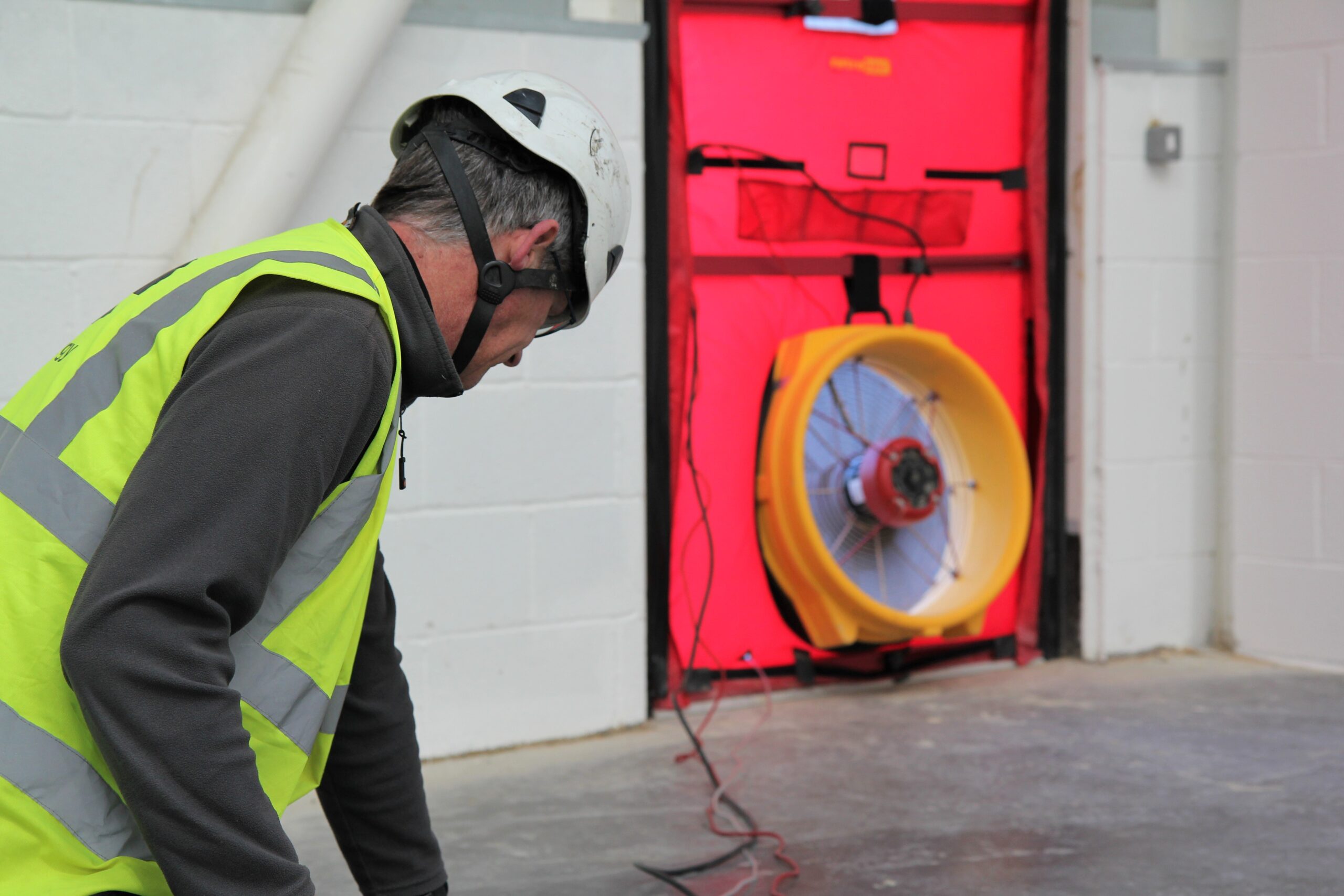
Why Choose Build Energy for Air Tightness Testing?
- Discounts when combined with a SAP or SBEM calculations
- Local, accredited engineers covering Dorset, Hampshire and Wiltshire
- Same-day certification when you need it fast
- Practical advice before the test to help you pass first time
- Volume pricing for larger sites and multi-plot schemes
- UK-wide coverage also available for sites outside our local area, from our Christchurch office
Do You Need an Air Tightness Test?
The type of project determines whether you need a test, and when. The table below covers the most common scenarios – if you’re not sure where your project sits, our engineers are happy to check the specifics against Approved Document L before you book.
| Project type | Air test required? | Notes |
|---|---|---|
| New dwelling (any tenure) | Yes | Mandatory under Part L; result feeds into the as-built SAP calculation |
| New non-domestic building | Yes | Mandatory under Part L; result feeds into the as-built SBEM calculation |
| Extension to an existing dwelling | Not usually | Treated as an existing building under Part L in most cases |
| Conversion or change of use | Case-by-case | Depends on the extent of works and your Building Control body’s approach |
| Refurbishment with no envelope changes | No | No changes to the building fabric means no test is triggered |
How Air Tightness Testing Works
Air testing uses fan pressurisation to measure how much air leaks through gaps and joints in the building envelope. It follows ATTMA Technical Standard L1 for dwellings or L2 for non-domestic buildings. Our engineer temporarily fits a calibrated fan to an external doorway to pressurise and depressurise the building while taking airtightness readings, so we can test most homes and small commercial units within a couple of hours. We take a proactive approach to the test itself, flagging obvious air leakage paths as we go – gaps around service penetrations, loft hatches and trickle vents are common culprits. That gives you the chance to fix them before the test rather than after a fail. Read our blog on getting your building airtight.
Recent Air Tightness Tests Across Dorset & Hampshire
A selection of local projects where our engineers have carried out air tightness testing and consultancy:
- Canford School, Dorset – air tightness desktop review, on-site consultancy and final testing for a £2.5m library and hall refurbishment.
- The Grange, Stubbington, Hampshire – SAP, airtightness and Part E sound testing for a 16-home residential development.
- Adanac Park, Southampton – Part L energy modelling and airtightness testing across 10 industrial and warehouse units.
- Upton Country Park, Poole – thermal comfort analysis and air permeability testing for BCP Council’s new Welcome Centre.
- Veterans’ Bungalows, Bournemouth – air permeability testing, SAP assessments/EPCs and sound insulation testing for a new veterans’ housing scheme with Greendale Construction.
Frequently Asked Questions
What areas do you cover for air tightness testing?
We’re based in Christchurch, Dorset, and cover sites across Dorset, Hampshire and Wiltshire within around a 50-mile radius, including Bournemouth, Poole, Southampton, Winchester and Salisbury. We also provide air tightness testing further afield across the rest of the UK from our Christchurch office. Local sites benefit from same-day certification and discounts when you combine testing with SAP or SBEM.
Do I need an air test for a house extension?
Part L treats most single extensions to an existing dwelling as work on an existing building, so they don’t trigger a standalone air tightness test. Building Control can treat larger extensions, conversions, or projects that significantly change the building’s envelope differently, so it’s worth checking the specifics with your Building Control body or with us before you plan the programme.
How long does an air tightness test take, and when do I get the certificate?
Most domestic tests take one to two hours on site, depending on the size and complexity of the building. We provide same-day certification wherever possible, so you’re not left waiting on paperwork to complete a SAP or SBEM sign-off.
How quickly can you book an air tightness test in Dorset, Hampshire or Wiltshire?
Because we’re based in Christchurch, we can often arrange local tests at short notice – sometimes within a few days – and issue your certificate the same day. This helps you fit testing around a tight construction programme without holding up sign-off.
Call 0330 055 34 05 · email be@buildenergy.co.uk · or tell us about your project →