
Planning authorities in London and other dense urban areas routinely require sunlight analysis where a new development could overshadow neighbouring properties. This applies to residential schemes in most high-density urban areas. Consultants typically submit a sunlight assessment alongside daylighting calculations as part of a combined BR 209 report. It is a material consideration for schemes of three or more storeys.
What is Sunlight Analysis?
Sunlight analysis assesses how a proposed development affects the annual probable sunlight hours (APSH) reaching neighbouring windows and outdoor amenity spaces. Build Energy uses the BRE guidelines on vertical sky component and sun on ground as the reference standard. Required by planning authorities for residential schemes in London and other high-density areas where overshadowing is a material planning consideration, sunlight analysis is typically submitted alongside daylight calculations as part of a BRE-compliant daylight and sunlight report. Build Energy’s consultants produce planning-accepted sunlight analysis reports for developments across England and Wales.
Daylight or Sunlight?

Daylight from an overcast sky remains broadly consistent regardless of building orientation. Sunlight on the other hand refers to direct sunshine and is very much brighter than ambient daylight.
On a cloudy or overcast day diffused daylight still shines through windows, even when sunlight is absent. Take particular care when the development sits to the south of existing buildings. In the northern hemisphere, south-facing facades receive the most direct sunlight.
In the UK (and other northern hemisphere countries) south-facing facades will, in general, receive most sunlight, while north-facing facades will receive few sunlight hours during summer months, specifically early mornings and late evenings.
Sunlight levels are unlikely to be a determining factor for viability of new developments, but their analysis may assist an application.
How does sunlight analysis work?
Build Energy carries out analysis following BRE guidance, British Standards, CIBSE design guides and established good practice for site layout.
Note that this guidance is there to help rather than constrain the designer – they are not instruments of planning policy and are not mandatory. Planning authorities may wish to use their own targets.
Sunlight analysis allows us to establish the effect of proposed new development – that includes the effect on the new occupants and those existing occupants in neighbouring buildings.
| Sunlight Analysis | Daylighting Calculations | |
|---|---|---|
| What it assesses | Direct sunlight reaching neighbouring windows and outdoor amenity spaces | Diffuse daylight levels within proposed new rooms |
| Key metric | Annual Probable Sunlight Hours (APSH) | Average Daylight Factor (ADF) and Vertical Sky Component (VSC) |
| Standard | BRE 209 | BRE 209 and BS 8206-2 |
| Applies to | Impact on neighbouring properties from a proposed scheme | Daylight compliance for the proposed development itself |
| Submitted together? | Yes – usually combined in a single BR 209-compliant daylight and sunlight report | |
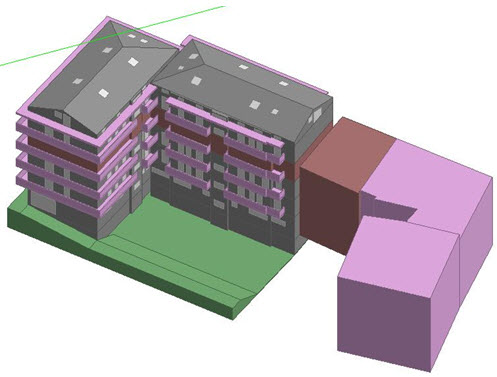
3D Modelling
The first step is to build a 3D computer model. This model is built based on digital files, surveys and architectural drawings.
Where available some data may be taken from information available online. A full size model will be built of the existing area, including existing buildings and neighbouring properties.
We then analyse this model using a suite of different software modules.
Annual Probable Sunlight Hours (APSH)
APSH is an indicator used to demonstrate the percentage change before and after the proposed development.
Planning guidance expects the greater part of any overshadowing from a new extension to fall within the applicant’s own site. The major factors that will affect the amount of overshadowing are height, distance to boundary, size of plot, orientation and topography.
Frequently Asked Questions
What is sunlight analysis and when is it required?
Sunlight analysis assesses the level of direct sunlight available to proposed and existing properties, and the impact of new development on neighbouring buildings and gardens. Planning authorities commonly require it for residential schemes – particularly in urban areas – where new buildings could significantly reduce sunlight to habitable rooms or amenity spaces in neighbouring properties.
Do I Need a Sunlight Report for a London Planning Application?
Most London boroughs expect a sunlight report alongside a daylight assessment for residential schemes of three or more storeys, or wherever a new building could overshadow neighbouring windows or gardens. The London Plan and individual borough policies point to BR 209 as the technical standard. A sunlight report that follows BR 209 methodology therefore meets the requirements of most London planning authorities. Build Energy prepares BR 209-compliant sunlight reports for planning applications across London and the wider South East.
Which sunlight analysis methodology applies in the UK?
Sunlight analysis in the UK follows the BRE guidance document Site Layout Planning for Daylight and Sunlight (BR 209). The principal metric is Annual Probable Sunlight Hours (APSH), which measures the percentage of annual sunlight hours received before and after a development. The assessment uses a 3D model of the site, existing buildings, and the proposed scheme to calculate shadow and sunlight availability at each window and garden under assessment.
What Is the Annual Probable Sunlight Hours (APSH) Test?
The Annual Probable Sunlight Hours (APSH) test measures the proportion of total available annual sunlight hours that a point or window receives, expressed as a percentage, before and after a proposed development. BR 209 recommends that main living rooms of dwellings should receive at least 25% APSH in total and 5% during the winter months (21 September to 21 March). If the reduction in APSH caused by a proposed development exceeds these thresholds at neighbouring windows, the planning authority may require design changes to mitigate the impact.
What Is a Sun-Hours-on-Ground Study and How Is It Presented?
A sun-hours-on-ground study checks how much sunlight a garden or other amenity area keeps once a proposed development goes up, tested on the spring equinox (21 March). BR 209 recommends that at least half of the amenity area should still get at least two hours of sunlight on that date. We present the assessment as a shadow diagram overlaid on the site plan, comparing the area that keeps adequate sun-hours against the area that loses them. It’s typically included alongside the APSH assessment in a combined BR 209 daylight and sunlight report.
Can sunlight analysis support a planning appeal?
Yes. Planning authorities and appeal inspectors accept sunlight analysis reports as technical evidence at planning appeals and public inquiries. A well-prepared APSH assessment, produced by an independent consultant and cross-referenced against BR 209 thresholds, can help demonstrate that a development’s impact on neighbouring amenity is within acceptable limits. Build Energy has prepared sunlight analysis for both applicants and objectors across a range of residential and mixed-use schemes.
Call 0330 055 34 05 · email be@buildenergy.co.uk · or tell us about your project →