
Thermal bridge calculations quantify heat loss through junctions, gaps, and penetrations in a building’s insulation layer. The results feed directly into SAP, SBEM, and Passivhaus energy calculations, and regulators are increasingly scrutinising Psi-values and linear thermal transmittance as part of fabric performance compliance.
What is a Thermal Bridge?
A thermal bridge occurs where there is a break in the insulation layers within a building, which acts as a path for heat to escape. They can account for approximately 30% of the heat loss from a building, so it is important to assess and minimise their impact where possible.
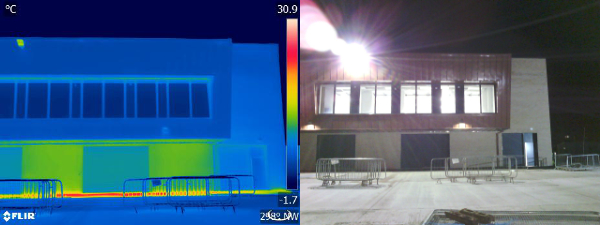
A thermographic image showing heat loss through a floor junction.
There are several types of thermal bridge and Psi-values are used to properly represent the effect of linear thermal bridges which occur at the junction between building elements, such as:
- Junction between a ground floor and exposed wall
- Lintels, sills, window and door jambs
- Junction between roof and exposed wall
How Thermal Bridge Calculations Reduce Heat Loss
The way new buildings are assessed in the UK has changed significantly, and the true impact of thermal bridging is now better understood. In many cases, it is a necessity to carry out thermal bridge calculations (Psi-values) on new build and refurbishment schemes.
Why are thermal bridge calculations important?
Both SAP Calculations and SBEM Calculations are used to assess for compliance with Part L of the Building Regulations, and they both require that the heat loss associated with linear thermal bridges is included within the calculations.
Where the Psi-value associated with a thermal bridge is unknown, default values should be used which represent a worst-case scenario. Using default values is likely to make complying with the building regulations extremely difficult.
For more standard construction methods, such as Masonry Construction or Timber Frame constructions, there are published thermal bridging values which can be used within calculations as per the links below:
Masonry Cavity
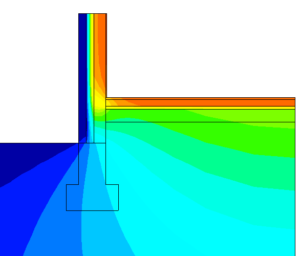
A 2D junction modelled using Trisco software.
- LABC Registered Construction Details
- Concrete Block Association Thermal Bridging Details
- Aircrete Product Association – Constructive Details MPA Precast
Timber Frame
- Trada Detail Drawings
- Accredited Construction Details – no longer accepted for current building regulations.
However, these details do not include all thermal bridges which occur in a building, and other construction types do not currently have published sets of details which can be adopted within the design of your building.
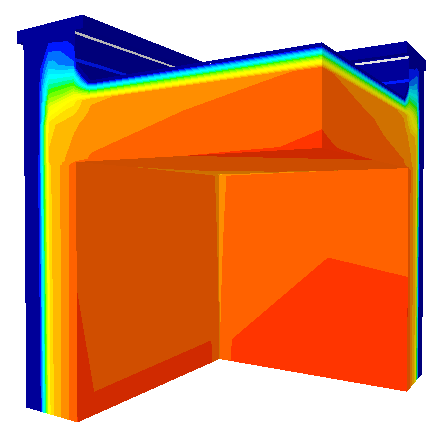
A 3D model showing heat losses around a junction.
Where the proposed construction details do not align with one of the existing published sets above, our experienced assessors can carry out Psi-value calculations in accordance with BR497 methodology. These can then be used within SAP and SBEM calculations to avoid the use of poor default values, and where necessary advise measures which could be adopted to help reduce the thermal bridge.
For modern methods of construction or volume house builders, we can assess your typical construction details which can then be optimised and used for all sites which follow the same details.
For further reading see What are Psi-values?
Frequently Asked Questions
What is a thermal bridge and why does it matter?
A thermal bridge is a point or junction in the building envelope where heat escapes more readily than through the surrounding construction – typically where insulation is interrupted by a structural element or at junctions between building elements. Thermal bridges can account for around 30% of a building’s total heat loss, making them a significant factor in energy performance. Minimising thermal bridging improves SAP scores, reduces heating demand, and lowers the risk of condensation and mould.
What is a Psi-value?
A Psi-value (ψ-value) is a measure of the additional heat loss per metre length of a linear thermal bridge, expressed in W/m·K. It quantifies the heat lost at a junction – such as a wall-to-floor junction or a window reveal – beyond what would be lost through the surrounding fabric alone. Psi-values are calculated using specialist software and used in SAP calculations and Part L compliance assessments.
When are thermal bridge calculations required?
Thermal bridge calculations are required whenever a project uses specific Psi-values in its SAP calculation rather than the default Accredited Construction Details (ACDs). Using calculated Psi-values rather than defaults typically improves the SAP score significantly. They are also required for Passivhaus certification, some BREEAM credits, and increasingly as a condition of planning consent or building control sign-off on higher-performance schemes.
How are thermal bridge calculations carried out?
Build Energy uses specialist 2D and 3D finite element software to model heat flow through construction junctions and calculate Psi-values. We assess all key junctions – including ground floor edges, wall-to-roof junctions, window and door reveals, and lintels – and produce a full set of calculated Psi-values for use in SAP or as standalone evidence for building control and planning.
Call 0330 055 34 05 · email be@buildenergy.co.uk · or tell us about your project →