
Overheating assessments evaluate whether a building is likely to overheat under current and future climate conditions. Additionally, they are required under Part O of the Building Regulations for new residential buildings in England, and may also be required by local planning authorities or BREEAM assessors.
What is an Overheating Assessment?
Overheating assessments evaluate the risk of excessive indoor temperatures in residential buildings using CIBSE TM59 methodology, demonstrating compliance with Part O of the Building Regulations and – for London schemes – the GLA’s overheating policy. Required for all new residential dwellings in England under Part O, assessments use either simplified analysis or dynamic thermal modelling depending on the building’s cooling strategy and solar exposure. Build Energy’s accredited engineers provide TM59 assessments and dynamic simulation modelling for apartments, houses, and mixed-use residential schemes across the UK.
TM59 Overheating Assessments
As a result, Build Energy provides accredited TM59 overheating assessments for projects across the UK, ensuring compliance with Part O of the Building Regulations and the London Plan.
Why Overheating Analysis Matters for UK Buildings
- Climate resilience – UK summers are getting hotter; buildings must adapt.
- Protect occupant health & comfort – Prevent heat stress, sleep disruption, and vulnerability in warm indoor environments.
- Meet planning and Building Regulations – Ensure your design complies with Approved Document O and avoids delays or redesigns.
- Avoid costly retrofits – Identify overheating risk early to build smart, not expensive.
- Improve energy efficiency – Balance passive cooling and mechanical systems to reduce operational energy use.
Understanding UK Overheating Regulations
What is Part O?
Approved Document O (introduced in 2022) is a legal requirement under Building Regulations in England. It sets out strategies to mitigate the risk of overheating in new residential buildings – from homes and student flats to care homes.
Who needs an overheating assessment?
Overheating assessments apply to:
- New residential dwellings
- Student accommodation
- Care and nursing homes
- Conversions and refurbishments
- Commercial buildings (where overheating is a concern)
Key compliance standards
- TM59 – Used for assessing overheating risk in new dwellings (aligned with Part O)
- TM52 – Commonly used for non-domestic buildings
- BB101 – specific guidelines for Schools
- Dynamic Simulation Modelling (DSM) – Advanced software-based simulations to test building performance under real-life weather conditions
- SAP Calculations – Required alongside overheating assessments for new dwellings to demonstrate Part L energy compliance
How is an Overheating Assessment Performed?
Simplified Overheating Assessment
The simplified method is a quicker, rule-based approach applicable to standard dwellings under Part O. It is ideal for straightforward developments and assesses key factors like:
- Glazing ratios
- Window orientation
- Ventilation openings
- External shading
However, this method is fast and cost-effective but not suitable for all projects, especially in dense urban areas or high-risk designs.
Dynamic Simulation Modelling (DSM)
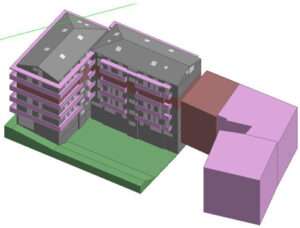
For complex or high-risk schemes, we use Dynamic Simulation Modelling.
Learn more about our DSM services ›
- Accurately simulates hourly internal temperatures using real weather data
- Required for buildings with:
- High glazing ratios
- Limited natural ventilation
- Urban heat island exposure
- Unusual layouts or orientations
Together, TM59 and TM52 form the foundation of these simulations, ensuring robust, compliant results.
How to Reduce Overheating Risks in Buildings
Passive Design Strategies

- External shading (brise-soleil, shutters, balconies)
- Smart window placement and sizing
- Natural ventilation through crossflows and stack effect
- Night purging to release stored heat
Mechanical Cooling Solutions

- Therefore, considered where passive design cannot control overheating
- Includes ceiling fans, MVHR with cooling, or air conditioning
- As a result, careful integration ensures energy targets are still met
Smart Building Design Considerations

- Use of thermal mass to regulate internal temperatures
- Landscaping to reduce solar gain (trees, green roofs)
- Early-stage DTM to steer architectural decisions
Frequently Asked Questions
What is an overheating assessment, and why do I need one?
An overheating assessment identifies the risk of internal spaces becoming uncomfortably warm. It’s a mandatory requirement under Part O for most new dwellings in England.
What’s the difference between a Simplified Method and Dynamic Thermal Modelling?
The Simplified Method is a quick, rule-based approach suited to straightforward, lower-risk developments. Dynamic Simulation Modelling (DSM) is a software-led, in-depth analysis required for complex or higher-risk schemes, or where the simplified method cannot demonstrate compliance.
Does my building need an overheating risk assessment?
Yes, if you’re delivering:
- New homes or flats
- Conversions to residential use
- Student or care accommodation
- Some commercial spaces with high internal gains
What happens if my building fails an overheating assessment?
Don’t worry – we’ll advise on remedial options such as:
- Adjusting glazing ratios
- Adding external shading
- Introducing mechanical cooling or improving ventilation
How much does an overheating assessment cost?
Costs depend on the method and complexity, but typically range between £350.00-£1,200.00 for single dwellings. Furthermore, efficiencies can be made when combining with services like:
- SAP/SBEM assessments
- Daylight/sunlight studies
- Energy strategy support
Which other services are required before, during or after an overheating analysis?
Build Energy also offers:
- Energy Statements (planning stages)
- SAP Calculations (technical design)
- SBEM Assessments (technical design)
- Daylight/Sunlight Assessments (technical design)
- Thermal Bridging & PSI Value Calculations (technical design)
- Airtightness Consultancy & Testing (design and completion)
Consequently, these can be integrated into your project timeline for maximum value.
Call 0330 055 34 05 · email be@buildenergy.co.uk · or tell us about your project →