
Whole Life Carbon Assessment (WLCA) quantifies the total carbon emissions associated with a building across its complete lifecycle. This covers material extraction and construction through to operation, maintenance, and eventual demolition. As the UK construction sector moves towards net zero, whole life carbon has become the primary metric for genuine sustainability evaluation. It covers both embodied and operational carbon in a single, standardised assessment.
What is a Whole Life Carbon Assessment?
Whole Life Carbon (WLC) assessments quantify the carbon emissions associated with a building across its entire life cycle. These cover embodied carbon from materials and construction, operational carbon from building services, and end-of-life emissions. Required by the London Plan for major development schemes, WLC assessments are increasingly specified by planning authorities and developer ESG policies. Frameworks including RIBA 2030 targets and the UKGBC Net Zero Carbon Buildings Framework have made them standard practice for net-zero developments. Build Energy’s engineers produce RICS-aligned whole life carbon assessments for developers, architects, and contractors across the UK.
Although we have been measuring operational emissions from buildings for some time (i.e the impact of occupying and operating a building), Whole Life Carbon Assessments give us much better understanding of the impact of those emissions already ‘built in’. These embodied emissions can contribute 40-70% of total emissions in a new building.
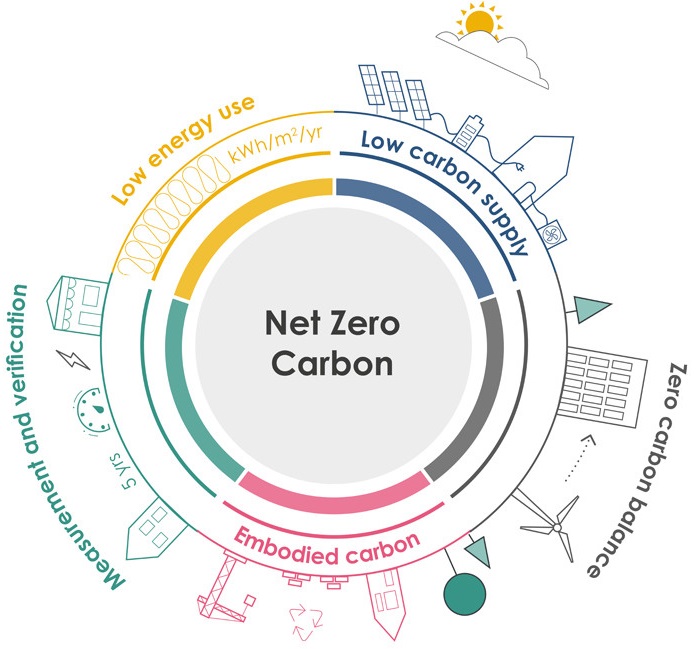
A Whole Life Carbon Assessment (WLCA) is a crucial process that evaluates a building’s carbon emissions throughout its entire lifecycle. It considers the carbon footprint from the construction phase to the building’s end-of-life, including every stage in between.
By focusing on both embodied and operational carbon, a WLCA ensures a comprehensive understanding of a building’s total environmental impact.
A WLCA works alongside Life Cycle Assessment (LCA), which evaluates broader environmental impacts beyond carbon, and Life Cycle Costing (LCC), which provides the financial counterpart by modelling whole-life costs.
Whole Life Carbon emissions include those operational emissions from regulated and unregulated energy use, and embodied carbon. Embodied carbon covers the carbon emissions from:
- Raw material extraction
- Manufacture of products
- Transport of materials
- Construction
- Maintenance, repair and replacement
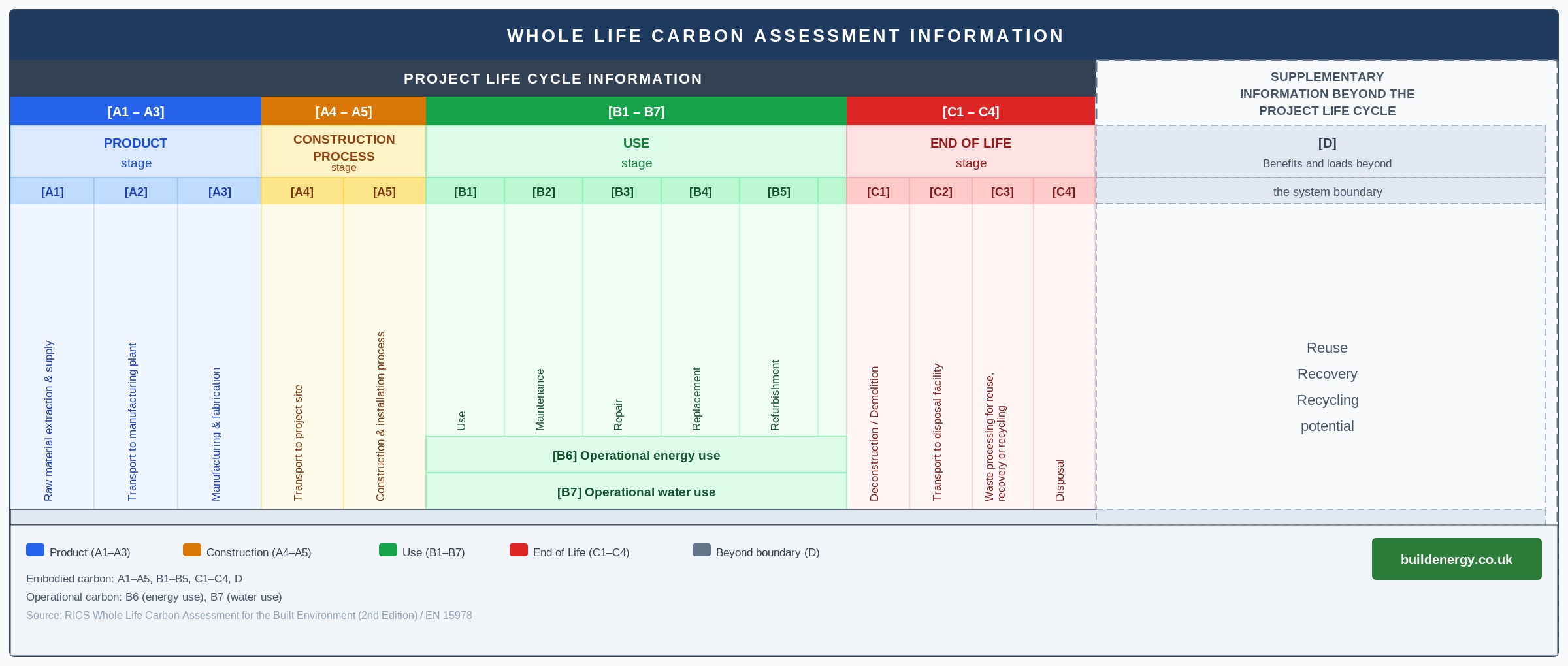
- Demolition and disposal (see table at bottom of page)
How Does Whole Life Carbon Assessment Work?
Assessing Embodied Carbon
The assessment process begins with an analysis of the materials and methods used in construction. This stage evaluates embodied carbon, which includes the emissions produced during the extraction, manufacturing, and transportation of building materials.
Evaluating Operational Carbon
The operational carbon, emitted during the building’s use, is also assessed. This step considers energy consumption for heating, cooling, and lighting, among other factors.
Examining the End-of-Life Phase
The final stage examines the end-of-life phase, assessing the emissions from demolition, disposal, and recycling. The data collected from all these stages provide a clear picture of the building’s overall carbon footprint.
Benefits of Conducting a Whole Life Carbon Assessment
Conducting a WLCA offers numerous benefits. It helps in identifying carbon hotspots, enabling the implementation of strategies to reduce emissions. Additionally, it supports compliance with environmental regulations and enhances the building’s marketability by showcasing its sustainability credentials.
Moreover, by opting for materials with lower embodied carbon and improving energy efficiency, a WLCA can lead to significant cost savings over the building’s lifetime.
Our Approach to Whole Life Carbon Assessment
Guidance & Benchmarking
Whole Life Carbon assessments are guided by the RICS Whole life carbon assessment for the built environment’ Professional Statement (November 2017) document. RICS developed this guide to standardise whole life carbon assessments. It provides specific guidance on the methodology outlined in EN 15978.
As a result, a WLCA ensures teams mitigate carbon impacts throughout the project lifecycle. Furthermore, the reporting should allow future comparisons of results and enable benchmarking and target setting.
At present, two primary benchmarks are available–the benchmarks provided within the RICS Professional Statement and those recommended by LETI (London Energy Transformation Initiative). These benchmarks allow clients to see how their buildings perform in comparison.
RICS guidance states that substructure and superstructure must be included in the assessment. Additionally, the design team can include facilitating works, finishes, building services, and external works, provided they confirm the necessary information.
Life Cycle Stages
The tables below outline the scope of a WLCA and refer to the emissions associated with different life cycle stages. According to RICS guidance, it is mandatory to include Stages A1-A5, B4, and B6 within an assessment.
London Plan Requirements
The Greater London Authority (GLA) sets it’s own guidance around Whole Life Carbon. Policy SI2 of the London Plan 2021 requires that planning applications include a Whole Life Carbon assessment. This must show a calculation of WLC emissions and demonstrate how these emissions have been reduced throughout the planning and design phases.
While an assessment is supported and encouraged for all major applications, it is mandatory for all developments referable to the Mayor. These typically include:
- Schemes of more than 150 residential units
- Development over 30 metres in height outside the City of London
- Development on Greenbelt or Metropolitan Open Land
- All applications, whether outline, detailed, or hybrid
A WLCA should be submitted at the following stages:
- Pre-application (where relevant)
- Planning application submission (i.e., RIBA Stage 2/3)
- Post-construction (i.e., prior to occupation of the development). Generally, it would be expected that the assessment would be received three months post-construction.
Generally, the GLA requirements follow the RICS Professional Statement as outlined above. However, some differences exist in the GLA requirements, such as the reporting of operational carbon emission factors and the use of TM54 assessments for non-residential operational carbon.
Circular Economy Statements
A move away from the current linear economy – where companies use materials and then discard them – is necessary. In a circular economy, materials remain at their highest value for as long as possible before re-use and recycling, thereby minimising waste.
The circular economy principle focuses on the more efficient use of materials, which, in turn, leads to financial efficiency.
According to London Plan Policy SI7, developers must produce a Circular Economy Statement in alignment with the energy strategy for the site and with the WLCA. Build Energy can produce this in tandem with your WLCA where required.
Frequently Asked Questions
What is the difference between embodied carbon and operational carbon?
Embodied carbon refers to greenhouse gas emissions produced during the manufacture, transport, installation, maintenance and disposal of a building’s materials. These emissions occur before, during and after occupation. Operational carbon comes from the energy used to run the building during occupation – for heating, cooling, lighting and appliances. A Whole Life Carbon Assessment combines both, giving a complete picture of a building’s total climate impact over its full lifespan.
When is a Whole Life Carbon Assessment required?
The London Plan (Policy SI 2) requires a WLCA for major developments in Greater London as part of the energy strategy submitted with a planning application. Beyond London, many local planning authorities are introducing similar requirements under net zero planning policies for larger residential and commercial schemes. WLCA is also required for BREEAM Excellent and Outstanding ratings under the Ene and Mat categories.
What does a Whole Life Carbon Assessment report include?
A WLCA report quantifies carbon across four lifecycle modules. These are: A (upfront embodied carbon), B (operational and in-use emissions), C (end-of-life demolition and disposal) and D (reuse and recycling benefits). We report results in kgCO₂e/m² and benchmark them against RICS and GLA targets. The assessment covers the full building envelope, structure, services and fit-out, using EPD data where available.
How does a Whole Life Carbon Assessment inform design decisions?
A WLCA is most valuable when carried out early in the design process, ideally at RIBA Stage 2. At this stage, material and structural choices are still open. By quantifying the carbon impact of different design options, teams can make evidence-based decisions. This applies to choices such as concrete versus steel structure or different insulation specifications. Build Energy works iteratively with architects and engineers to model alternatives and identify the highest-impact carbon reduction opportunities.
Call 0330 055 34 05 · email be@buildenergy.co.uk · or tell us about your project →