
SAP calculations (Standard Assessment Procedure) are the UK Government’s approved methodology for demonstrating compliance with Part L1A of the Building Regulations. Every new home in England and Wales must meet three targets. These are: a Target Emission Rate (TER) for carbon dioxide, a Target Fabric Energy Efficiency (TFEE) rate, and minimum fabric performance standards covering walls, roofs, floors and windows.
Build Energy’s accredited SAP assessors produce both design-stage and as-built reports. They serve house builders, architects and self-builders across England, Wales and Scotland.
In short, SAP stands for ‘Standard Assessment Procedure’. It is the only official, government approved system for assessing the energy rating for a new home. A SAP assessor is also known as an On Construction Domestic Energy Assessor (OCDEA). They must be accredited and registered with a certification body like Elmhurst.
What is a SAP Rating?
In essence, a SAP Rating is a way of comparing energy performance of different homes. Specifically, it results in a figure between 1 and 100+ (100 representing zero energy cost and anything over means you are exporting energy). Consequently, the higher the SAP rating, the lower the fuel costs and the lower the associated emissions of carbon dioxide. Additionally, the SAP Calculations establish an energy cost based on the construction of the home, its heating system, internal lighting and any renewable technologies installed. It does not take account of energy used for cooking or appliances.
Why SAP Calculations Matter
In order to meet current building regulations, home builders will need to gain a ‘pass’ within the assessment. Without it, building control will not sign off the development and the property cannot be let or marketed for sale.
It has also been confirmed that a new version of SAP will be used to assess new homes against the Future Homes Standard. This sits alongside the Home Energy Model.
There are other reasons to care about the SAP Assessment. A SAP assessor can help the designer or architect to shape the energy profile of a new dwelling – minimising its energy use and carbon emissions. As a result, the effect of different construction types, heating systems and technologies can be accurately measured and delivered on the ground.
Another key point is that the SAP rating broadcasts the energy performance of the property, and in turn informs the Energy Performance Certificate (EPC) which all buyers and tenants see.
A ‘pass’ is gained by meeting several compliance targets around:
- How well the fabric of the dwelling contains heat
- Solar gain
- Quality of construction and commissioning of systems
- Predicted CO2 emissions from the dwelling
Emissions are king
The headline emissions target is achieved using the DER/TER figures. CO2 emissions are measured by comparing a Target Emission Rate (TER) against the predicted Dwelling Emission Rate (DER). Specifically, this target rate is set within the SAP assessment by reference to a notional dwelling. This is a version of the proposed home, of the same size and shape, using a set of baseline values. Importantly, these CO2 figures are now increasingly used by planners and councils to drive other objectives – from meeting sustainability targets and local renewable energy policy to determining 106 – type community contributions. 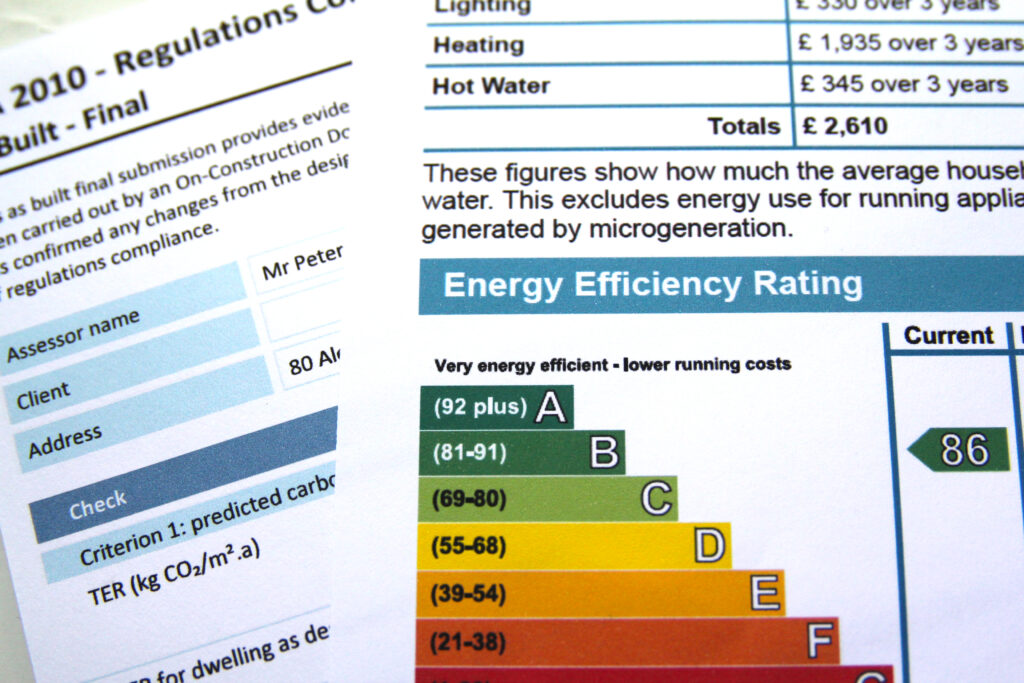
Fabric Energy Efficiency
Since April 2014, homes built in England are also assessed on Fabric Energy Efficiency. This is not a measure of carbon, but energy demand in units of kilowatt-hours per m2 per year. How well a home retains the heat it produces will have an impact on its CO2 emissions as well as being assessed separately to gauge compliance. Fabric Energy Efficiency is assessed using DFEE/TFEE figures. As with emissions the target is set within SAP using a set of baseline values depending on the size of the property.
The Primary Energy Rate
The TPER moves the building regulations towards promoting lower energy demand buildings. It takes into account the environmental impact of each fuel type, alongside the system efficiency. The Primary Energy Rating is generated by giving each form of fuel a Primary Energy Factor, applying this to the building’s energy demand. Where Renewables are used, these will be subtracted from the final energy demand before the TPER is calculated.
What a SAP Assessment Involves
A SAP Assessor will work from architects plans and construction detail, together with a full HVAC (heating, ventilation and air conditioning) specification. For this reason drawings need to be scaled, accurate and show all elevations, sections, floor and site plans.
Building the model
The assessor will scale off of these plans either electronically or by hand to create a replica of the proposed dwelling(s) in accredited SAP assessment software. 
Building Services
Once the site form is established, the heating, lighting and ventilation systems are added – specific products will be picked from manufacturer databases where they are known.
Construction Details
Additionally, all thermal elements (walls, floors, roofs and openings) are added in detail together with all calculations for thermal junctions. Any renewable technologies and cooling are also added.
Outputs
Once complete, a SAP calculation produces a wide range of detailed outputs. These cover site form, heat losses and energy demand, through to seasonal variations, CO2 emissions and renewables contributions.
Iteration
Importantly, many homes do not pass first time and will not initially comply with Part L. This is a critical part of the assessment process. The assessor, client and designer will need to explore different options together. This may require running further assessments with alternative technologies and construction types to arrive at a compliant assessment.
How to Meet SAP Compliance Requirements
It’s fair to say that developers and architects didn’t need to pay much attention to SAP in the old days – but recent years have brought significant changes to the SAP metrics and Part L Building regs. Starting work without a design stage SAP assessment is not an option! This is primarily because CO2 emissions targets have tightened enormously – driven as they are by European and UK climate policies. An average new build designed just 5 years ago is highly unlikely to pass the regulations today. We are often asked to explain why some builds fail and some pass, and it isn’t always easy to give a straight answer. Numerous factors can play a part. These range from the heat pump model and wall junctions, to floor insulation thickness and the direction the house faces.
Tips for a Successful SAP Assessment
We carry out SAP calcs every day – spanning single self builds through to 30 storey apartment blocks, so we have a good idea of what works and what does not. Setting climate targets aside and ignoring the technical details, a few clear principles will help. These give most projects a good chance of compliance:
1. Minimum U-values are there to be beaten, not followed
If the fabric of the building is well insulated, expensive renewable technologies become unnecessary. Improve your U-values by designing as much insulation into the walls, floors and roofs as you possibly can.
2. Windows and doors lose a lot of heat
Pay attention to the u values on the openings you are specifying. Aim for 1.4 W/m2K or lower
3. Avoid fossil fuels
Switching to a future proof electric heat pump system will greatly improve your results.
4. Get it airtight
In addition, all new builds require Airtightness Testing on completion and the resulting figure goes into the SAP Calcs. Make sure the envelope is sealed and get a pre-test check carried out.
5. Pay attention to thermal bridging
This is heat loss through junctions with external walls. For example, follow a scheme such as Accredited Construction Details (ACD’s) which will allow us to avoid using default figures. For our guide see our page on Thermal Bridging.
6. Renewables
Furthermore, adding solar photovoltaic panels to your design can have a huge impact on the Part L targets.
Start early!
The one key point – even more important than those above, is to start early. If we receive a set of plans half way through a build, there’s not a lot we can do to change the energy performance of that building. This scenario also leads to much bad practice and usually the installation of unsuitable, expensive technologies added in hindsight just to pass building regs or to meet a planning condition. Avoid this by engaging with your SAP assessor as early in the process as possible – often this will be well before planning has even been submitted, and certainly well before building regs applications.
SAP Calculations for Extensions and Conversions
Many extensions, conversions and change of use schemes will require SAP Calculations under Part L1b of the building regs:
- Extensions with more than 25% glazing-to-floor area (SAP Calculations for Extensions)
- Barn conversions
- Commercial to domestic conversions
- Conversion of a single dwelling into flats or apartments
Related Services
SAP calculations sit alongside a range of related compliance and sustainability services. Most new build schemes also require an Energy Statement for the planning application. Once built, all new dwellings require an air permeability test to demonstrate airtightness compliance. For commercial and mixed-use buildings, see Part L SBEM Calculations. Return to the SAP Calculations hub.
Frequently Asked Questions
What does SAP stand for?
SAP stands for Standard Assessment Procedure. It is the UK government’s approved method for calculating the energy performance of dwellings, used to demonstrate compliance with Part L of the Building Regulations and to produce Energy Performance Certificates.
What is the difference between a design-stage SAP and an as-built SAP?
A design-stage SAP (or Predicted Energy Assessment) is based on the proposed specification and is submitted to building control before construction begins. The as-built SAP is completed after construction, reflecting any changes made on site, and is used to lodge the final EPC on the national register.
What information is needed to produce a SAP calculation?
Build Energy typically needs floor plans and elevations showing dimensions and orientation, the construction specification (U-values for walls, roof and floor), window and door specifications, details of the heating system, hot water provision, and any renewable energy measures. The more complete the information, the faster the turnaround.
What is a good SAP rating?
SAP ratings run from 1 (very poor) to 100+ (highly efficient). Most new homes built to current Part L standards achieve ratings between 80 and 90. An EPC rating of A requires a SAP score of 92 or above. The exact target depends on the Part L version applicable to your project.
Does Build Energy work with housing associations and volume housebuilders?
Yes. Build Energy provides SAP calculations for single self-build plots, housing association schemes and large-volume housebuilder sites. For larger sites, we typically agree a standard specification with the design team and apply it consistently across all plot types, with variations tracked and recalculated as needed.
Who does SAP calculations in the UK?
SAP calculations must be carried out by an accredited SAP assessor registered with a UKAS-approved scheme such as Elmhurst Energy. Build Energy’s assessors are Elmhurst-accredited and provide SAP calculations for new builds, conversions and extensions across England, Wales and Scotland, producing both design-stage and as-built reports for Planning and Building Regulations compliance.