
Part F Ventilation Testing for New Buildings
Part F ventilation testing must be completed after installation of mechanical ventilation systems in new build dwellings, before building control sign-off. Build Energy tests and commissions MEV, MVHR and dMEV systems across England and Wales, and can combine the visit with air permeability testing to minimise site attendance.
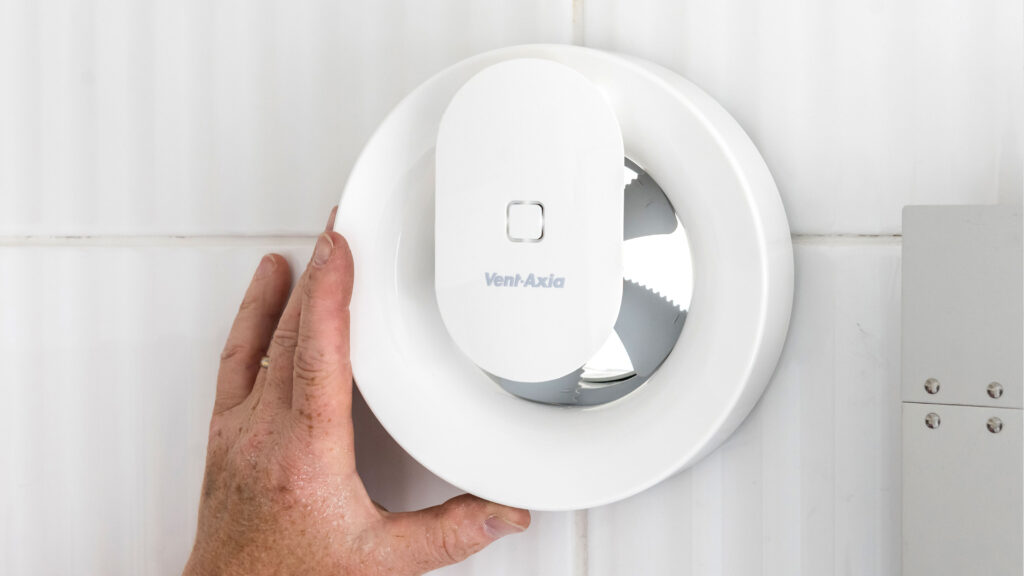 Part F Testing – Why Test?
We are essentially demonstrating that the fan is performing how it is intended. Extract fans will come with performance figures showing air flow in litres per second. For example a typical bathroom fan would be expected to extract at a rate of 15 litres per second.
In the real world, many fans do not perform to their rating and this is often due to poor ductwork design or installation.
Part F of the Building Regs applies to ventilation requirements, and was last updated in December 2010. In reality we are only recently seeing it’s enforcement and an inconsistent approach from building control bodies, which makes it very difficult to plan for. However we are seeing much higher scrutiny of ventilation systems within new and conversion schemes and even small domestic extensions.
Ventilation designers should adhere to certain good practice and design when specifying ventilation systems. There are 5 different ventilation types, ranging from simple background and intermittent fans, to whole house mechanical extract systems with heat recovery. These are labelled as ‘Systems 1 – 5’.
The testing in this case deals with System 1 fans only – those typical intermittent fans fitted in ceilings and walls which are individually controlled. Part F testing validates air flow measurements for the new dwelling and ensures that the system has been configured correctly.
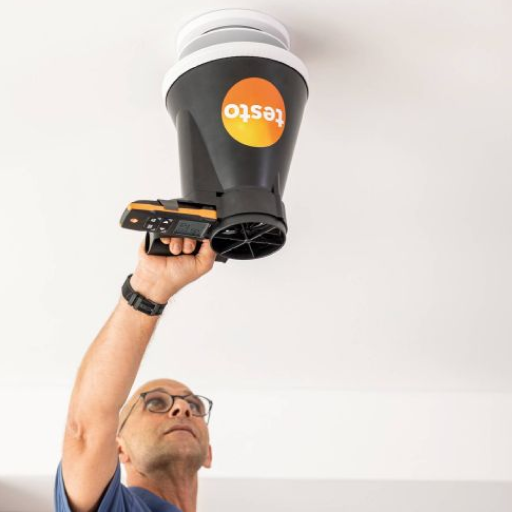
Portable testing equipment used to test intermittent fans
What is Part F Ventilation Testing?
The methods and procedures for measuring air flows are set out in the Domestic Ventilation Compliance Guide (DVCG) and this sets out several ways to demonstrate compliance.
The rules state that all fixed fans should be tested, and evidence supplied to Building Control within 5 days. In the main we will be testing ‘System 1’ background ventilation systems – the type most commonly seen and consisting of intermittent extract fans and other background ventilation, like trickle vents.
Other systems, like whole house mechanical ventilation (‘MV’ or ‘MVHR’ systems) will usually be commissioned and tested by the qualified installer.
Testing should be carried out using UKAS calibrated equipment.
Minimum air flow by use (litres per second):
Kitchen Adjacent to hob 30 l/s
Elsewhere 60 l/s
Utility 30 l/s
Bathroom 15 l/s
Sanitary Accomodation 6 l/s
The most common method for fan testing is the use of a vane anemometer, which is a measuring device held up to the fan terminal with an appropriate hood attachment. The results of each fan test are evidenced in a report produced by the tester.
If the measured air flow of a fan does not meet the design flow intended, then the test is marked a fail and a retest will be needed.
We highly recommend reading our Part F Ventilation Testing Blog before installing any extract fans if possible, and in preparation for your tests.
- Discounts when combined with air permeability testing
- Full UK coverage
- Vastly experienced team of qualified engineers
- UKAS calibrated equipment
- Practical advice prior to the test to
- Discounts for volume scheme
Related Services
Ventilation performance directly affects SAP calculations for dwellings – poor ventilation rates can affect the energy rating. For building fabric airtightness, see Air Tightness Testing. For indoor air quality compliance, see Indoor Air Quality Plan. Return to the Air Quality hub. For post-construction air quality testing and BREEAM Hea 02, see Indoor Air Quality Testing.
Frequently Asked Questions
What is Part F ventilation testing?
Part F of the Building Regulations requires that mechanical ventilation systems in new dwellings are commissioned and tested to demonstrate that they deliver the specified airflow rates. Testing includes fan performance tests (measuring extract and supply air flow rates) and a commissioning sheet submitted to building control. The requirement applies to all mechanical extract ventilation (MEV), mechanical ventilation with heat recovery (MVHR) and decentralised mechanical extract ventilation (dMEV) systems.
Which ventilation system types need testing under Part F?
All mechanical ventilation systems in new dwellings must be tested and commissioned under Part F, including MEV (centralised mechanical extract ventilation), MVHR (mechanical ventilation with heat recovery), dMEV (decentralised mechanical extract ventilation) and any other fan-assisted system. Natural ventilation through trickle vents does not require fan testing.
What happens if ventilation rates are below specification?
If fan performance testing shows airflow rates below the design specification, the system must be adjusted or repaired and re-tested. Low airflow rates typically result from blocked ductwork, incorrect fan settings, poor installation or high duct resistance. Build Energy identifies the cause and advises on remediation.
Does ventilation testing need to be submitted to building control?
Yes. Under Part F, a commissioning notice confirming that the ventilation system has been installed and tested in accordance with the design specification must be submitted to building control as a condition of receiving a completion certificate.
Can Build Energy test ventilation systems on large residential developments?
Yes. Build Energy carries out Part F ventilation testing and commissioning on large residential schemes – including apartment blocks, houses and mixed-use developments – across England and Wales. We can test MVHR, MEV and dMEV systems and produce the commissioning documentation required by building control.
Call 0330 055 34 05 or email be@buildenergy.co.uk.